
The BRICS summit offers Modi an excellent platform to reach out to world leaders and conduct diplomacy on the very ticklish issue of reform of the world governance structure, and to exchange notes with his peers on international, regional and bilateral issues on the margins of the meeting, says Rup Narayan Das.

In spite of irritants and hiccups in the relationship, a few deliverables are expected of the prime minister's visit to China, says Rup Narayan Das.

As the context of Panchsheel has changed, it is all the more essential that India and China need to reinvent and redefine Panchsheel for a new world order taking into account globalisation, and mutual economic interdependence. The new Panchsheel, in order to be relevant, needs to shed its binary approach of west verses the east recognising the seamlessness of global frontiers, which globalisation has brought in, says Rup Narayan Das.
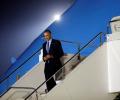
'Obama's visit to Hiroshima must generate a fresh debate in the international community about how to reduce the salience of nuclear weapons in international politics and how to disarm the world from these monstrous weapons forever,' says Sanjeev Shrivastav..

When a Chinese warship entered Japanese waters, the Indian commander called on China to maintain discipline at sea. Dr Rajaram Panda explains the significance of the Malabar exercises between India, Japan and the US.

The main culprit in vitiating the inter community/caste/class relations has been the so called 'targeted' approach. This is nothing but discrimination on the basis of faith/caste/class. When an equally poor and deprived child is denied scholarship, despite equal merit, resentment begins to brew, says Colonel (retd) Anil Athale.
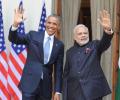
The greatest challenge before India is how to strike a fine balance of its relationship between its neighbour and strategic rival China, and the US.

There are some larger policy issues related to the submarine as a platform and the modernisation programme of the navy that merit brief recall and review, says C Uday Bhaskar
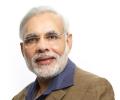
The major driver of Mod's foreign policy can be gauged from his economic priorities such as creating employment opportunities for the youth bulge. Related to this is emphasis on manufacturing, and infrastructure development, which in turn raises the issue of FDI. He has already articulated his views on all these issues, says Rup Narayan Das.

India has made a good beginning in the area of satellite navigation but still there is a long way to go.

'Often reviled, mostly ignored, sometimes venerated, he has taken it all in his stride.' 'He has stood by the nation through thick and thin,' says Brigadier Gurmeet Kanwal (retd).

Some questions cited concerns that larger warnings can hurt tobacco farmers and boost illicit trade.

Besides weakening the Maoists' lethal capacities and reducing violence, it is essential to ensure that governance is improved, so that those prone to sympathising with, or supporting, the Maoists would, in the long run, realise the needlessness and futility of doing so, says P V Ramana and Raj Bala Rana.

Colonel Anil Athale (retd) recalls how the Battle of Panipat, 258 years ago, changed the history of India for the next century and half.

'China's growing nexus with Pakistan and the two countries' unresolved territorial disputes with India continue to pose a formidable national security threat to India,' says Brigadier Gurmeet Kanwal (retd).
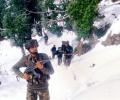
The army of the future needs a system of transparency and research. An open sociology of the army is a democratic necessity. An openness of information is a necessity of the army of the future fighting the next peace and next war on behalf of society, says social scientist Shiv Visvanathan.

'A collapsing Pakistan may well unleash its nuclear weapons as the last throw of the dice. With a nuclear arsenal of over 50 bombs, even a regional nuclear exchange can devastate the world.'

'By beheading an Indian soldier, the Pakistan army has demonstrated its proclivity for barbaric medievalism.' 'The strategies adopted and the punishment inflicted by India must be made progressively more stringent with every new act of terrorism till the cost becomes prohibitive for Pakistan,' says Brigadier Gurmeet Kanwal (retd).

50 years after the 1965 War, India still thinks we can have a 'limited war' when our opponent has time and again shown it does not believe in a limited war, says Colonel Anil A Athale (retd).

It is rare for communal riots to spread to rural areas. The UP riot is the first time after the September 1969 Gujarat riots that a rural area have been affected. Electoral politics which divide society in majority/minority, going on since the early 1990s, is a major contributing factor to this heightened tension between communities, says Colonel (retd) Anil Athale in the first of a two part series.
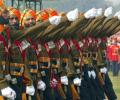
The average Indian soldier remains as hardy as before but he is certainly confused with the pace of change occurring all around him. It is here that the leaders -- the officers -- will have to adapt themselves to the new reality, says Nikhil Gokhale
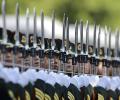
'After more than 20 years of understanding, nothing much seems to have been achieved. What the two countries have been trying to do is to manage the recurrence of border incursions. The two sides must address the disease, and not the symptom of the disease,' says Rup Narayan Das.

Today, the biggest challenge for any state is to evolve indigenous hardware options. It is important for the states like Germany, India etc to increase their stakes in the global IT setup and this could allow them to control the US domination, says Ajey Lele.
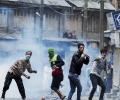
'Burhan Wani's killing served as a spark for the anti-establishment fire that has been raging in the minds of Kashmiris ever since the Centre stopped engaging them for their political future,' says Air Vice Marshal (retd) Kapil Kak in an interview with Rediff.com

'The message to India is (with attacks like Pathankot) basically what the Pakistani army is trying to test is how serious are you when it concerns the peace process with that country.'

Anti-nuclear activist S P Udayakumar, who has been called a threat to the economic security of India by the Intelligence Bureau, speaks to A Ganesh Nadar.
.jpg)
In India, the need to find a solution for the jobs problem is perhaps even more urgent considering the oft-quoted number of a million young people arriving every month looking for jobs.

India has built two top-secret facilities in Karnataka to enrich uranium in pursuit of its hydrogen bomb dream.
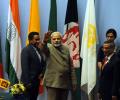
'If his three priorities are the economy, the economy, the economy, then there is need for a stable region, a stable neighbourhood.'
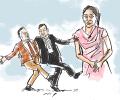
Dressed in pink, her hands flying about in eloquent gestures, excitement on her face, Indrani made quite a picture. There was pin-drop silence as she made strong points about why nothing in the hearings had uncovered anything against her. She spoke about there being "Not a shred of evidence... No scientific evidence because it didn't happen!"


Happy with her latest move, Indrani departed from Courtroom 51 with a spring in her step. The woman who hopped up into the jail truck was a cheerful one.

The warmest reception came from his soon-to-be ex wife Indrani, who on spying him getting out of the lift, muttered an "Oh dear!" and walked over to him, trailed by her police guards, wreathed in high-wattage smiles.
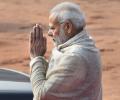
Prime Minister Narendra Modi on range of issues -- from Rafale deal to Ram temple and triple talaq.

Dr P K Menon, Chief Scientist and CEO, Optimal Synthesis Inc, who worked with Dr A P J Abdul Kalam early on in his career, recalls what it was like working for his first boss.

'If Indian armed forces entered Pakistan and succeeded in inflicting major damage on the Pakistani army and occupied territory in the Pakistani heartland, there is reason to think the Pakistani military would use some nuclear weapons against the incoming Indian forces to compel India to stop.'
